
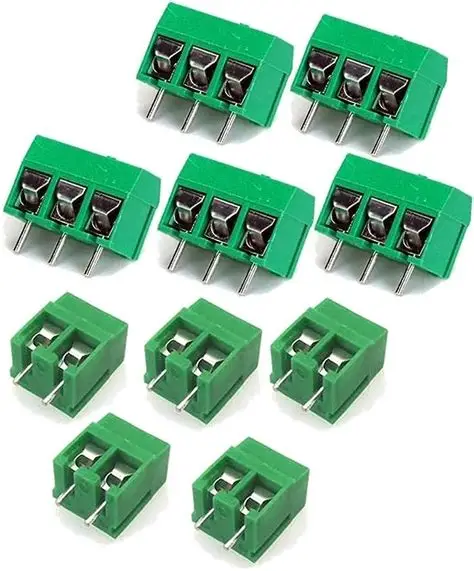
Terminal Blocks – 2-Pin/3-Pin/4-Pin/5-Pin
Snap‑into action with 2‑5 pin terminal blocks, your fast‑track to hands‑on STEAM circuit mastery!
+0 points earned
Terminal Blocks – 2‑Pin / 3‑Pin / 4‑Pin / 5‑Pin (Discrete Components)
These compact, screw‑type connector modules provide a reliable, reusable way to join wires and PCB tracks in low‑voltage circuits. Each block houses a row of spring‑loaded contacts that clamp onto stripped wire ends, creating a secure, solder‑free junction that can be opened or reconfigured in seconds. Available in 2‑, 3‑, 4‑ and 5‑pin configurations, the series lets students build everything from simple LED circuits to multi‑sensor data‑loggers without the hassle of permanent solder joints.
Working with terminal blocks teaches core STEAM concepts: students practice circuit design, signal routing, and safe wiring techniques, while also exploring mechanical tolerances, material properties, and the physics of electrical contact resistance. The hands‑on nature of the blocks encourages iterative prototyping, troubleshooting, and documentation, key skills for engineers, makers and scientists.
Key Features
- Rated for 250 V / 10 A (typical) – suitable for most classroom projects.
- Color‑coded housing for quick pin identification.
- Spring‑loaded clamps for easy wire insertion (22‑24 AWG) and removal.
- Robust plastic housing (UL‑94 V‑0 flame‑retardant) for durability.
- Compatible with breadboards, perfboards, and custom PCBs.
Why it shines in STEAM education
The modular nature of terminal blocks bridges the gap between abstract circuit theory and tangible, real‑world building. Students can experiment with modular robotics, renewable‑energy prototypes, and IoT sensor networks, swapping connections on the fly to test hypotheses and iterate designs. Their reusability reduces waste, aligns with sustainability goals, and keeps project costs low, making them an ideal, versatile tool for any hands‑on STEM curriculum.