
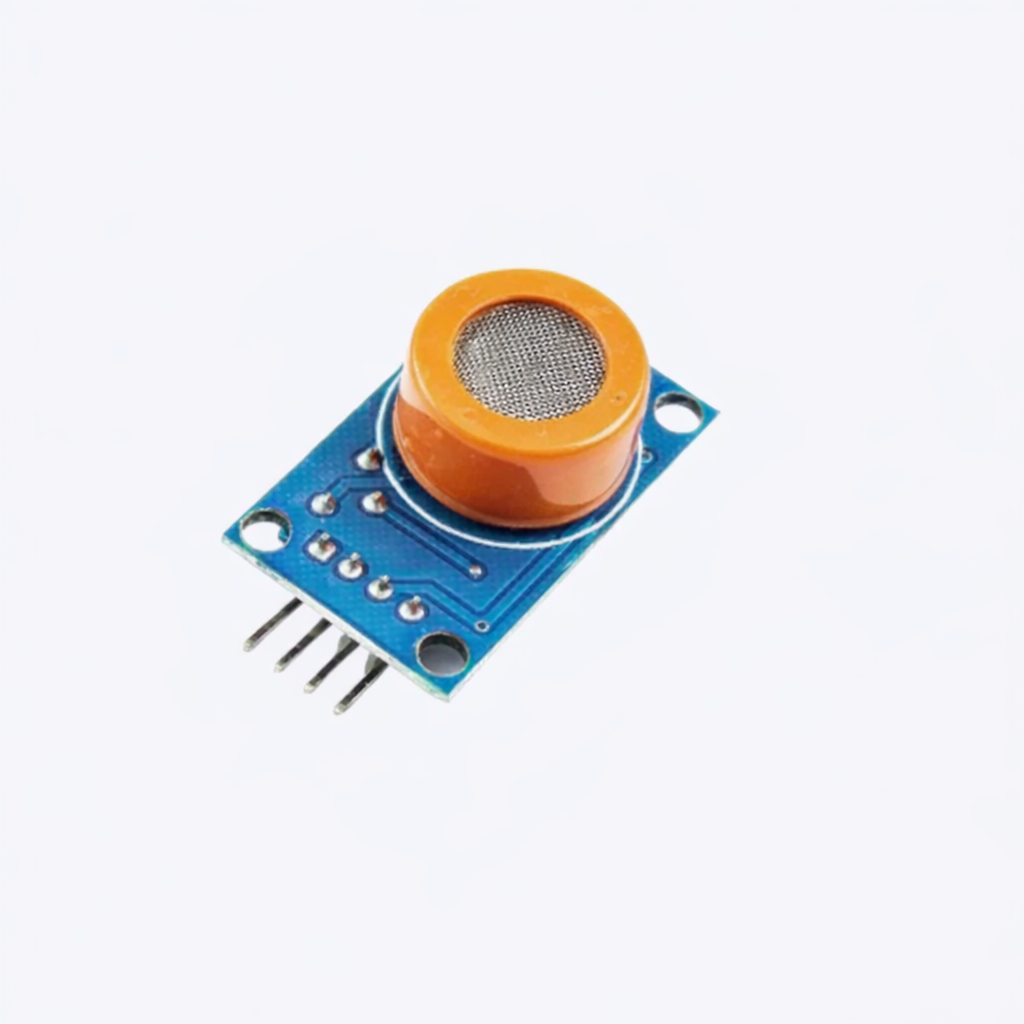
MQ-3 Alcohol Sensor Module
MQ-3 Alcohol Sensor Module lets STEAM learners detect air quality and explore gas sensing through hands‑on experiments.
+0 points earned
MQ‑3 Alcohol Sensor Module – Environmental Sensors
The MQ‑3 is a compact, low‑cost semiconductor gas‑sensor that detects ethanol vapor (and other volatile organic compounds) in the air with high sensitivity. Housed in a ready‑to‑wire breakout board, the module delivers an analog voltage output that varies proportionally to the alcohol concentration, making it ideal for Arduino, Raspberry Pi, ESP32, and other microcontroller platforms. It’s perfect for classroom labs, maker‑space projects, and research prototypes that need real‑time monitoring of breath, spills, fermentation, or indoor air quality.
What students will learn:
- The chemistry of semiconductor gas‑sensing and how oxidation/reduction reactions change resistance.
- Calibration techniques, data‑logging, and conversion of raw voltage to parts‑per‑million (ppm) values.
- Design of feedback loops (e.g., “smart” breath‑alcohol detectors) and integration with Bluetooth, LCD, or IoT dashboards.
- Critical thinking about sensor limitations, cross‑sensitivity, and environmental factors such as temperature and humidity.
Key features
- Sensitive to 0.04 %–5 % (400 ppm–50 000 ppm) ethanol, with response time < 1 s.
- Wide operating voltage: 5 V ± 0.5 V; analog output (0–5 V) plus optional digital “heater” control.
- Built‑in heater circuit for stable baseline; pre‑calibrated resistance values provided on the silkscreen.
- Small footprint (≈ 30 mm × 20 mm) and pin‑compatible with standard breadboards.
Why it shines in STEAM education
The MQ‑3 bridges science (chemistry of gases), technology (microcontroller interfacing), engineering (circuit design, calibration), art (visualizing data with graphs, LEDs, or kinetic sculptures), and mathematics (curve‑fitting, statistical analysis). Its immediate, visible output lets students experiment with real‑world phenomena such as measuring alcohol levels in a mock “breathalyzer” or monitoring fermentation in a biology project while reinforcing problem‑solving, data‑driven design, and interdisciplinary collaboration. With the MQ‑3, classroom experiments become authentic, hands‑on investigations that inspire the next generation of environmental innovators.