
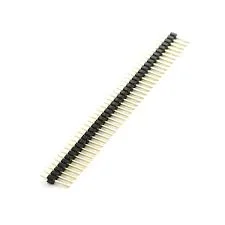
Male Pin Headers (2.54mm Pitch)
Snap, code, and create with 2.54 mm male pin headers, your gateway to hands‑on STEAM projects!
+0 points earned
Male Pin Headers (2.54 mm Pitch) – Connectors
These rugged, tin‑plated male pin headers are the backbone of any breadboard, prototype board, or custom PCB build. Each row of pins is spaced at the industry‑standard 2.54 mm (0.1 in) interval, allowing seamless insertion into standard prototyping strips, sockets, and jumper wires. Available in 2‑ to 40‑pin configurations, the headers are designed for low‑profile, high‑reliability connections that stay firmly in place even during repeated assembly and disassembly, perfect for classroom labs and makerspace projects alike.
What Students Will Learn & Why It’s a STEAM Staple
Using these pins, students explore the fundamentals of electronic interconnection, signal routing, and circuit modularity. They’ll practice designing schematics, laying out PCBs, and building reusable hardware “building blocks,” reinforcing concepts in physics (circuit theory), mathematics (binary and multiplexing), engineering (design‑for‑assembly), art (creative prototyping), and computer science (Arduino, Raspberry Pi, and micro‑controller programming).
Key Features
- Standard 2.54 mm pitch – compatible with every breadboard and perf‑board on the market.
- Durable, lead‑free tin plating – corrosion‑resistant for long‑term use.
- Varied pin counts (2‑40) – flexible for everything from simple LED blinkers to complex sensor arrays.
- Low insertion force, high retention – easy for young hands to plug and unplug without damage.
- RoHS‑compliant, lead‑free – safe for classroom environments.
Why It’s Great for STEAM Education
Because the male pin header is a universal connector, it lets students quickly prototype, test, and iterate ideas without soldering every component. This rapid‑feedback workflow encourages experimentation, problem‑solving, and interdisciplinary collaboration, core STEAM values. By mastering these simple yet powerful connectors, learners gain confidence to move from breadboard concepts to robust, soldered projects, bridging the gap between theory and real‑world invention.