
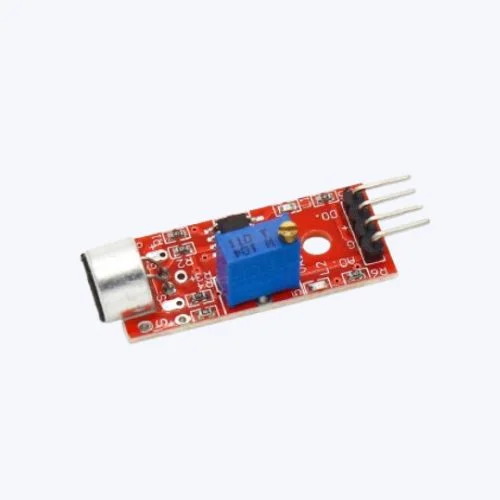
KY-037 Sound Sensor Module
KY‑037 Sound Sensor: capture and analyze sound waves to explore acoustic science through hands‑on STEAM learning
+0 points earned
KY-037 Sound Sensor Module – Environmental Sensors
The KY‑037 is a compact, low‑cost sound‑level detector that converts acoustic energy into an analog voltage and a digital “clap‑detect” output. Designed for Arduino, Raspberry Pi, micro:bit and other classroom‑friendly boards, the module lets students capture real‑world sound data from a whisper in a quiet lab to the roar of a traffic corridor, making it an ideal gateway to environmental monitoring and acoustic analysis.
Working with the KY‑037, learners explore the physics of sound waves, signal conditioning, and data acquisition while programming sensors, visualizing waveforms, and building projects such as noise‑maps, voice‑activated alarms, and interactive musical instruments. The hands‑on experience reinforces concepts in acoustics, electronics, data science, and algorithmic thinking, giving students a concrete link between theory and everyday phenomena.
Key Features
- Dual output: analog voltage (0 – 5 V) for precise amplitude measurement and digital “high/low” pin for simple sound‑triggered events.
- Adjustable sensitivity via on‑board potentiometer.
- Built‑in LM393 comparator for reliable noise‑threshold detection.
- Compact 5 × 3 cm footprint, breadboard‑compatible pins, and clear labeling for easy prototyping.
- Operates at 3.3 V–5 V, making it safe for younger learners and compatible with most classroom microcontrollers.
Why It Shines in STEAM Education
The KY‑037 bridges science (sound physics, environmental noise studies), technology (sensor interfacing, IoT data logging), engineering (circuit design, system integration), and art (interactive sound installations, music synthesis). Its immediate visual feedback encourages experimentation, while its versatility supports cross‑disciplinary projects from mapping schoolyard noise pollution to creating responsive light shows. By turning invisible sound into measurable data, the module sparks curiosity, nurtures problem‑solving skills, and empowers students to design smarter, quieter, and more responsive environments.