
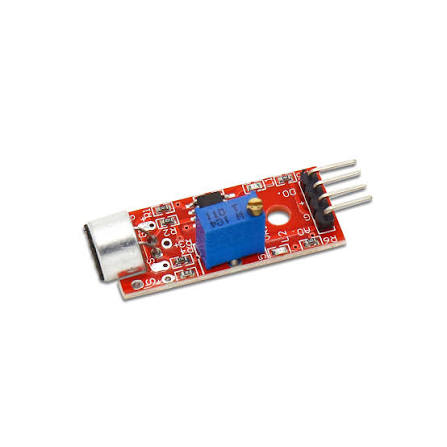
KY-037 / KY-038 Sound Sensor / Microphone
Turn real‑world sounds into code with the KY‑037/38 STEAM‑ready microphone sensor!
+0 points earned
What it is
The KY‑037/KY‑038 is a compact, low‑cost sound‑level sensor that combines an electret microphone, a built‑in amplifier, and both analog and digital output pins on a single breakout board. The module works with any 3.3 V‑5 V microcontroller (Arduino, ESP32, Raspberry Pi Pico, etc.) and includes a handy LED that flashes in proportion to the detected sound intensity, giving an instant visual cue of the acoustic environment.
What students will learn
Using this sensor, learners explore the physics of sound—frequency, amplitude, and decibel levels—while writing code to capture, filter, and react to real‑time audio data. Projects can range from simple noise‑threshold alarms to more sophisticated applications such as voice‑activated robotics, musical visualizers, environmental noise mapping, and interactive art installations. The hands‑on experience reinforces concepts in electronics (signal amplification, analog‑to‑digital conversion), programming (interrupt handling, data logging), and data analysis (FFT, sound‑wave plotting).
Key features
- Dual output: analog voltage proportional to sound pressure and a digital “high‑/low” pin with adjustable sensitivity.
- Adjustable gain: on‑board potentiometer lets students fine‑tune the microphone’s responsiveness.
- Built‑in LED indicator: provides immediate visual feedback for debugging and creative displays.
- Wide operating voltage (3.3 V‑5 V) and compatible pin layout for seamless integration with most classroom development boards.
- Compact size and low price make it ideal for large‑scale kits and iterative prototyping.
Why it’s great for STEAM education
The KY‑037/KY‑038 bridges science (acoustic measurement), technology (microcontroller interfacing), engineering (circuit design, sensor calibration), art (sound‑reactive installations, music visualizers), and mathematics (signal processing, statistical analysis). Its versatility encourages interdisciplinary projects that can be scaled from a single classroom demo to a school‑wide “noise‑aware” campus monitor. Because the hardware is inexpensive yet powerful, educators can give every student hands‑on access to real‑time audio sensing, fostering curiosity, problem‑solving, and collaborative invention.