
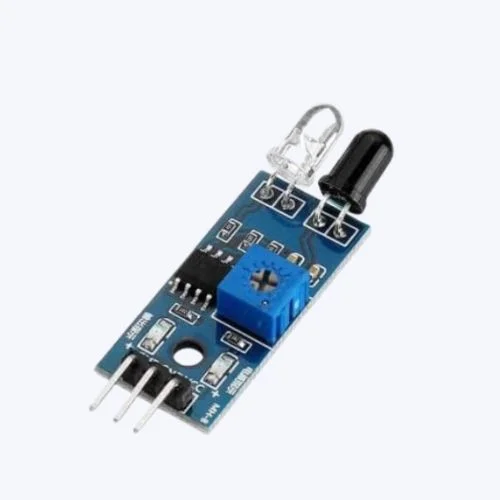
IR Sensor Module – Infrared Obstacle Detection for Robots & Automation
Detect obstacles with precision , the IR Sensor Module brings smart infrared vision to robots and automation projects.
+0 points earned
IR Sensor Module – Infrared Obstacle Detection for Robots & Automation
A compact, plug‑and‑play infrared sensor designed for hobbyists, classroom labs, and competition teams. The module combines an IR LED emitter, a paired photodiode receiver, and on‑board signal conditioning into a single board that mounts directly onto breadboards or robot chassis. When an object enters the sensor’s 2‑10 cm detection cone, the module outputs a clean digital HIGH/LOW signal that can be read by any microcontroller (Arduino, ESP32, Raspberry Pi Pico, etc.) or PLC.
What students will learn
‑ How infrared light can be used to sense distance and detect obstacles without physical contact.
‑ The basics of analog‑to‑digital signal processing, including filtering, hysteresis, and debounce techniques.
‑ Integration of sensor data into control loops for line‑following, wall‑avoidance, and autonomous navigation.
‑ Real‑world problem‑solving: designing, testing, and iterating a robot’s “sense‑and‑react” behavior.
Key Features
- Digital output (TTL 0 V / 5 V) for instant compatibility with most development boards.
- Adjustable detection range (2 cm – 10 cm) via a built‑in potentiometer.
- Wide operating voltage: 3.3 V – 5 V, low power consumption (< 30 mA).
- Compact 20 mm × 20 mm footprint with solder‑less header pins.
- Built‑in ambient‑light rejection for reliable performance under indoor lighting.
Why it shines in STEAM education
The IR Sensor Module brings together science (light physics), technology (microcontroller interfacing), engineering (robotic design), and mathematics (calibration curves) in a single hands‑on experiment. Its immediate visual feedback, an LED that flashes when an obstacle is detected, keeps learners engaged, while the open‑ended nature of the projects encourages creativity and iterative design. Because the sensor works with any standard coding platform, teachers can scaffold lessons from block‑based programming to full‑stack C/C++ code, making it a versatile bridge between introductory and advanced STEAM curricula.