
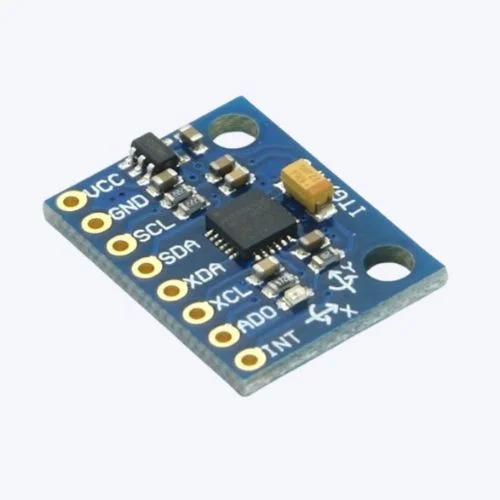
GY-521 Module with MPU-6050 – 6-Axis Motion Sensor
Explore motion and position with the GY‑521 ; a 6‑axis sensor powering hands‑on STEAM learning
+0 points earned
GY‑521 Module with MPU‑6050 – 6‑Axis Motion Sensor
The GY‑521 is a compact breakout board that houses the MPU‑6050, a proven 6‑axis inertial measurement unit (IMU) combining a three‑axis gyroscope and a three‑axis accelerometer. Plug‑and‑play compatible with Arduino, Raspberry Pi, ESP32, and most micro‑controller platforms, the board communicates via I²C (0.6 kΩ pull‑up) and supplies raw or filtered motion data in real time. Its small footprint (≈2 cm × 2 cm) makes it ideal for handheld prototypes, robotics, wearables, and interactive art installations.
What students will learn & why it shines in STEAM
Students explore the physics of rotation, linear acceleration, and vector math while coding sensor fusion algorithms (e.g., complementary or Kalman filters) to derive orientation, tilt, and gesture recognition. Hands‑on projects; balance bots, motion‑controlled games, kinetic sculptures, and data‑logging experiments, link engineering, mathematics, and creative design, reinforcing problem‑solving, coding, and scientific inquiry.
Key Features
- 3‑axis gyroscope (±250, ±500, ±1000, ±2000 °/s) and 3‑axis accelerometer (±2, ±4, ±8, ±16 g)
- On‑board Digital Motion Processor (DMP) for sensor‑fusion off‑loading
- Low‑power operation (3.3 V – 5 V) with configurable sleep mode
- Built‑in voltage regulator, EEPROM, and 6‑DOF data ready at up to 1 kHz
- Easy I²C interface; compatible libraries for Arduino, MicroPython, and CircuitPython
Why it’s perfect for STEAM education
The GY‑521 bridges theory and practice: learners witness abstract concepts like angular velocity and inertial frames materialize as measurable data. Its affordability and open‑source ecosystem encourage iterative prototyping, interdisciplinary collaboration, and real‑world problem solving from kinetic art to drone stabilization. By integrating motion sensing into classroom challenges, educators can spark curiosity, deepen computational thinking, and cultivate the next generation of makers and innovators.