
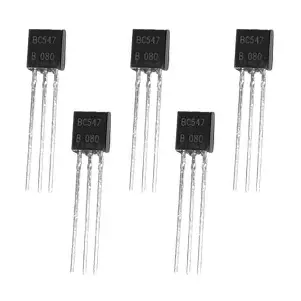
BC547B NPN Transistor(BC547B transistor)
BC547B NPN Transistor: a versatile switch and amplifier for your STEAM electronics projects.
+0 points earned
BC547B NPN Transistor – Discrete Component
The BC547B is a low‑cost, general‑purpose NPN bipolar junction transistor (BJT) that’s perfect for hobbyists, makers, and classroom labs. Housed in a standard TO‑92 package, this silicon device can handle collector currents up to 100 mA and operates reliably from 0 V to 45 V, making it ideal for switching, amplification, and signal‑conditioning circuits. Its “B” gain group (hFE = 200–450) provides a balanced mid‑range current gain, ensuring predictable performance for both beginner and intermediate projects.
What students will learn:
- Fundamentals of semiconductor physics – how charge carriers move through a BJT and why biasing is essential.
- Circuit design basics – building switches, amplifiers, and simple logic gates using the transistor as an active element.
- Hands‑on troubleshooting – measuring V_BE, V_CE, and using a multimeter or oscilloscope to verify transistor operation.
- Integration with microcontrollers – driving LEDs, relays, and motors from Arduino, Raspberry Pi, or ESP32 boards while protecting the controller’s pins.
Key features
- TO‑92 package for easy breadboarding and prototyping.
- Collector‑emitter voltage (V<sub>CEO</sub>) = 45 V, collector‑base voltage (V<sub>CBO</sub>) = 50 V.
- Collector current (I<sub>C</sub>) = 100 mA max; power dissipation (P<sub>D</sub>) = 0.625 W.
- Mid‑range gain group “B” (hFE = 200–450) for stable amplification.
- Wide temperature range (‑55 °C to 150 °C) for robust classroom experiments.
Why it’s great for STEAM education
The BC547B bridges theory and practice, giving students a tangible way to explore electronics, physics, and engineering concepts while fostering creativity in art and design projects. Its versatility lets educators design cross‑disciplinary labs, from building sound‑responsive LED sculptures to creating simple robotic actuators, illustrating how electrical principles power real‑world inventions. Because the transistor is inexpensive, readily available, and compatible with standard prototyping tools, it encourages iterative experimentation, critical thinking, and collaborative problem‑solving—core pillars of a STEAM curriculum.