
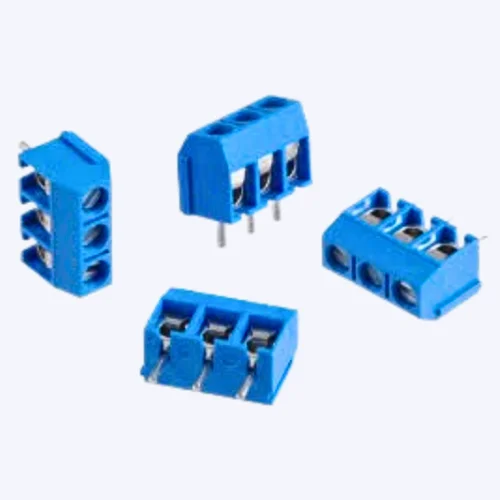
3 Pin Side-Entry Screw Terminal Block
Snap, screw, and power up projects fast with the 3‑Pin Side‑Entry Terminal Block; perfect for STEAM learning!
+0 points earned
What It Is & What Students Will Learn
The 3‑Pin Side‑Entry Screw Terminal Block is a compact, reusable connector that lets learners quickly and securely join three separate conductors to a PCB, breadboard, or prototype board. By inserting each stripped wire into the side‑entry opening and tightening the screw, students experience the fundamentals of reliable electrical connections, current flow, and circuit safety. Working with this terminal block reinforces core concepts such as series/parallel wiring, voltage division, and troubleshooting open‑circuit faults, essential skills for any budding engineer or maker.
Key Features & STEAM Benefits
- Side‑entry design – Fast, tool‑free wire insertion reduces build time and minimizes strain on delicate conductors.
- Robust screw‑clamp mechanism – Provides consistent contact resistance (≤ 30 mΩ) and can handle up to 10 A per pin, making it suitable for low‑power robotics, sensor arrays, and Arduino projects.
- Clear 3‑pin layout with labeling – Color‑coded or printed markings guide proper polarity and phase connections, helping students develop good documentation habits.
- Mountable on 0.1 in (2.54 mm) pitch boards – Fits standard STEAM kits and prototyping platforms, enabling seamless integration into multidisciplinary projects.
Because the terminal block bridges the gap between “breadboard‑only” experimentation and durable, real‑world assemblies, it encourages students to iterate from concept to functional prototype. Its hands‑on nature supports the STEAM pillars: Science (understanding electrical principles), Technology (working with industry‑standard hardware), Engineering (designing reliable connections), Art (creating tidy, organized layouts), and Mathematics (calculating load, resistance, and power). The 3‑Pin Side‑Entry Screw Terminal Block is therefore an ideal, low‑cost tool for classrooms, makerspaces, and hobby labs that want to empower the next generation of innovators.