
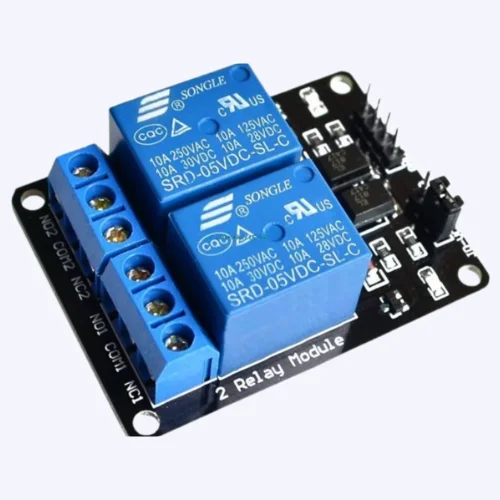
2-Channel 5V Relay Module
Control two high‑power circuits with ease; perfect for hands‑on STEAM projects!
+0 points earned
What it is
The 2‑Channel 5 V Relay Module is a compact, breadboard‑friendly board that lets you control up to two high‑power devices (lights, motors, solenoids, etc.) directly from a low‑voltage microcontroller such as an Arduino, Raspberry Pi, or ESP32. Each channel contains a 5 V optocoupler‑isolated relay, a built‑in flyback diode, and a convenient “COM‑NO‑NC” terminal layout, so you can switch AC or DC loads safely without exposing your board to the high current.
What students will learn
Working with this module introduces learners to the fundamentals of electromechanical actuation, signal isolation, and real‑world power management. Students will practice wiring the control pins, writing code to drive the relays, and measuring voltage/current with a multimeter, gaining hands‑on experience in circuit protection, debugging, and the difference between logic‑level and load‑level signals. The module also serves as a gateway to more advanced topics such as home automation, robotic actuation, and energy‑efficient design.
Key features
- Dual 5 V relays (10 A / 250 V AC or 10 A / 30 V DC) with built‑in flyback diodes
- Optocoupler isolation for safe microcontroller‑to‑load separation
- LED indicators for each channel’s status
- Clear COM‑NO‑NC screw terminals and a 2 mm pitch header for easy prototyping
- Compact 30 mm × 20 mm footprint, compatible with standard breadboards
Why it’s great for STEAM education
The 2‑Channel Relay Module bridges the gap between digital code and physical motion, turning abstract programming concepts into tangible, observable outcomes, perfect for interdisciplinary STEAM projects. Whether students are building an automated greenhouse, a robotic arm, or a smart alarm system, the module encourages creative problem‑solving, systems thinking, and hands‑on experimentation while reinforcing core science (electric circuits), technology (microcontroller interfacing), engineering (design of safe power‑handling circuits), and mathematics (calculating load requirements). Its low cost, robust construction, and clear documentation make it an ideal classroom and makerspace tool for fostering the next generation of innovators.